


India is probably not on most people’s travel bucket lists. Its associations of heat, dust, and congested streets are no doubt conjured by the colonial nostalgia in films of ill-fated romances unfolding in the British TV series “The Jewel in the Crown.” To many, India is either just the Taj Mahal, or a backdrop in other more recent cinematic fantasies: Christopher Nolan’s “The Dark Knight Rises” and “Tenet,” Paul Greengrass’s “The Bourne Supremacy,” and John Madden’s heartwarming “The Best Exotic Marigold Hotel.”
Western cinema doesn’t portray the country’s full story, but two faculty members thought they could paint a much clearer picture through an eighteen-day-long alumni tour across northwest India.
Professor of Philosophy Eric Palmer and I — Professor of Communication, Media, and Performance Ishita Sinha Roy — went all out and offered the ultimate fantasy: “Peacocks, Palaces, and Portals,” an exciting exploration of Indian mythologies, embedded histories, and blended cultures and traditions shaped by the shifting ethnic waves of settlers, invaders, and immigrants across the centuries. We set off in the early summer of 2026.
Exploring India’s History
After flying into India’s capital city, Delhi, we spent the first few days crisscrossing the two historical halves of a city that has witnessed great Mughal and Hindu empires, British rule, and the birth of Indian democracy. From the communal kitchen at a Sikh temple that provides free meals for tens of thousands each day to a theme park ride through Hindu civilization at another religious temple and visits to incredible heritage sites — including the spot where Mahatma Gandhi was assassinated — we had a lot to unpack already.
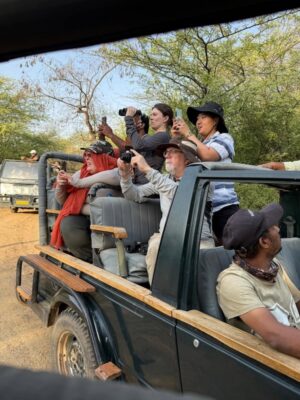
Tiger spotted at the Ranthambore Tiger Reserve. Photo credit: Vicki Bain
But time was of the essence and we soon took to the road, visiting several UNESCO World Heritage sites along our journey. We stopped in the ghostly fort city of Fatehpur Sikri, which was built and abandoned by a Mughal emperor. In the city of Agra, we watched the sunrise kiss the marble silhouette of the Taj Mahal — a sight so lovely it rivaled only the tomb’s own status as a symbol of eternal love. We rode along prowling tigers and roaming sloth bears during a jeep safari through a forest sanctuary nestled in the ruins of an 18th century fort. Ancient cities built by Hindu emperors centuries ago also lined our path: the pink city of Jaipur, the blue city of Jodhpur, and the white marble city of Udaipur.
Sharing and Gaining New Perspectives
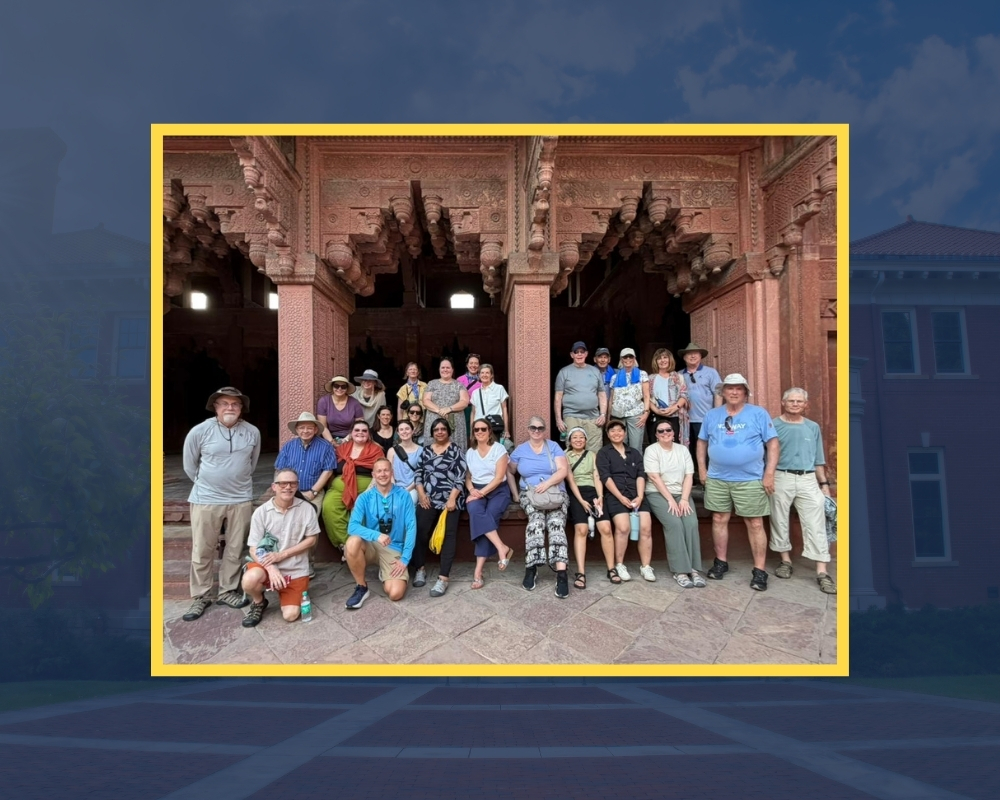
Our group of 32 participants included alumni across various cohorts from the Class of ’72 to the Class of ’23. You’d think a group so large and varied would be a recipe for disaster, but folks were surprised at how well the intergenerational mix worked.
“I talked with everyone on the trip, which was really special,” Gretchen Hilderbrand ’11 said. “It’s not often that people come together with such openness and interest in each other. I’m so grateful for the close friendships I made and the conversations that enriched my travel experience, and my ties to Allegheny 15-plus years post-graduation.”
Danny Smith ’82 echoed Hilderbrand’s sentiment.
“I truly loved this group — a fantastic mix of folks,” Smith said. “I miss them and would travel with any of them again.”
During the preparatory Zoom sessions prior to the tour, we explored the many “ideas of India” that have been formed by its multiple histories, alongside its present status as an emerging global stakeholder. Nothing, however, prepares you for the real deal.
As one of our group members put it, “I found an enormous land, full of so many people, a place that always seemed busy, and where so many currents — religions, ethnic groups, climates, and different classes — come together. An ancient land offering peace, yet marked by violence; the good alongside the bad; re-making itself into a new global powerhouse. We just scratched the surface.”
The Small Details Matter
It would be remiss if we don’t mention the details that made this journey extraordinary. Every room in the hotel at Agra, for instance, offered a view of the Taj Mahal. The meals were diverse and experiential — served in restaurants that were as much a visual feast as gustatory. One restaurant venue replicated the candle-lit mirrored splendor of ancient palaces, and another simulated a desert tent. A cooking lesson at a royal courtier’s mansion was followed by a puppet session, and then a fabulous home-cooked meal. The backdrop to one of our dinners was a shimmering lakeside circled by backlit palaces, while a rooftop meal offered a 360-degree view of a centuries’ old city, with a looming fort as a dramatic centerpiece. Our last meal — Indo-Mexican fusion — was a reminder that India continues to dance to a global drumbeat.
We saw rural and urban vignettes, enjoyed traditional cultural shows, and learned to massage rescued elephants. From a customized city walk with an art curator, to meeting various artisans at a tribal village, taking mad tuktuk rides down back alleys, and viewing the jaw-dropping collections in a royal jeweler’s private museum, India had everyone under its spell.
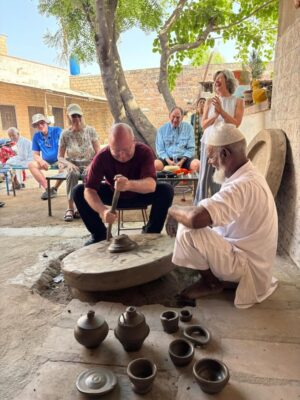
Trying balance and coordination skills at the pottery wheel in Bishnoi Village, Jodhpur. Photo credit: Cathleen Hadley-Samia
Multiple travelers remarked on the usefulness of the preparatory Zoom sessions, which helped them engage with their peers, introspect on their personal meanings of or purposes for the trip, and examine the country from an academic perspective with faculty leaders.
“The pre-trip [Zoom] sessions and extensive reading list and history to contextualize this trip truly speaks to what would set it apart from your typical foreign travel,” said Emily Benner ’12. “The intentional mix in spaces, encounters, and experiences revealed how diverse and complicated visiting another place and culture can be. From art to economics to philosophy, religions, and the more mundane lived experiences, this was a true embodiment of the liberal arts approach to continued learning and travel.”
By the end of the tour, everyone was asking when we could return, and which part of India we would explore next.
While it is evident that our group unanimously supports more alumni tours — especially to destinations they are hesitant to explore on their own — it drew some alumni closer to their alma mater once more.
“Prior to this trip, I felt disconnected from Allegheny,” Raina Gorman ’20. “I did not feel inclined to visit campus for events like Blue & Gold or Reunion Weekend. Now, I feel a stronger connection to Allegheny and a renewed appreciation for my status as an alum.”
Featured photo credit: Charles Gyanaraj