

Peter Fix ’87 and Kenneth Cohen ’98 uncovered an unlikely shared story in the last place any historian would look for a lead: an Uber.
The pair of colleagues shared a ride while heading to a meeting in Atlanta. When they got to talking, they were surprised to find they not only shared an Alma Mater, but both studied history in Arter Hall.
Two Allegheny Grads Collaborate
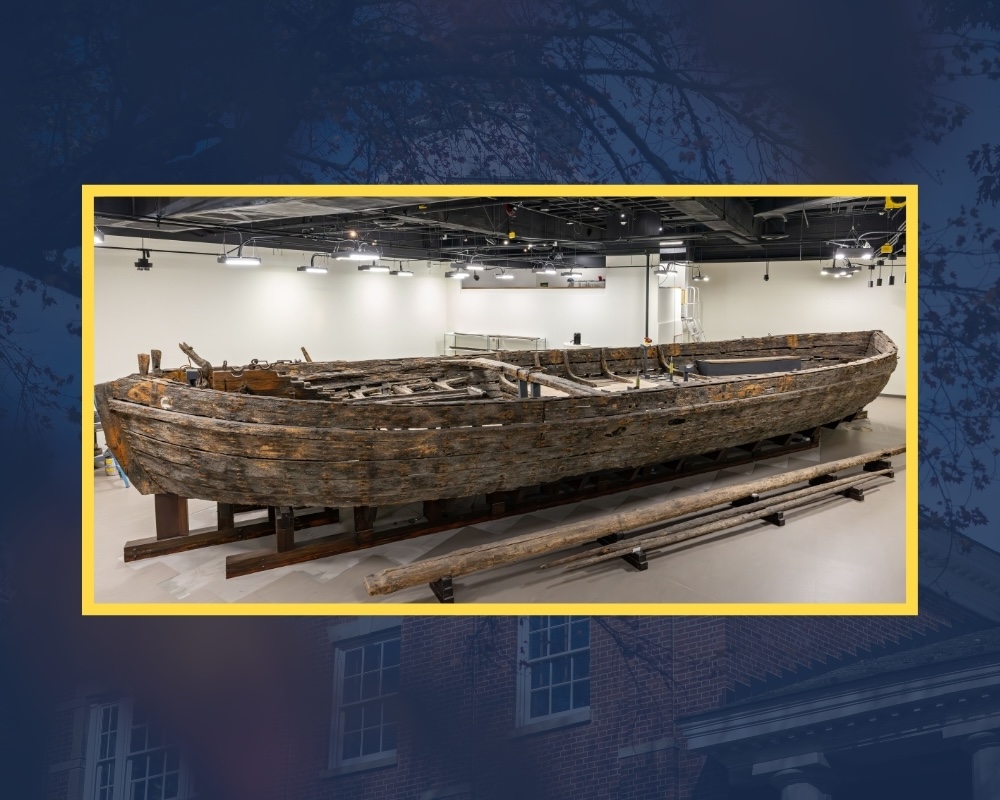
Even though Uber was at the heart of their encounter, it was a different event that drove them together. For six months prior, they both had been working to preserve the nation’s oldest surviving fighting watercraft, which dates back to the Revolutionary War.
“To have two Allegheny alums doing [preservation] work on this vessel is a real testament to the training that we got at the College and the ways we’ve been able to apply those skills over the course of our careers,” said Cohen, who majored in history and communications.
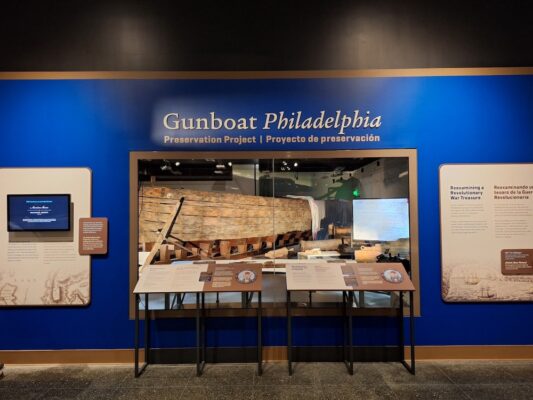
Without knowing their shared alma mater, Fix ’87 and Cohen ’98 worked on the Gunboat Philadelphia exhibit.
Cohen is the Chair of Military History and Curator of Early American History at the Smithsonian’s National Museum of American History, which receives over two million visitors a year. Fix, on the other hand, has spent the last few decades diving around the world as a watercraft conservator and Associate Research Scientist at Texas A&M University.
The Liberal Arts Advantage
At 53 feet long and 15 feet wide, the Gunboat Philadelphia was originally sunk on Lake Champlain in 1776 by the British. Both Cohen and Fix were independently assigned to the project after it — and a number of other historic preservation projects — received funding in celebration of America’s 250th anniversary.
Cohen noted that this type of work requires an explicit ability to explore the subject from a number of perspectives — a skill he attributes to his Allegheny education.
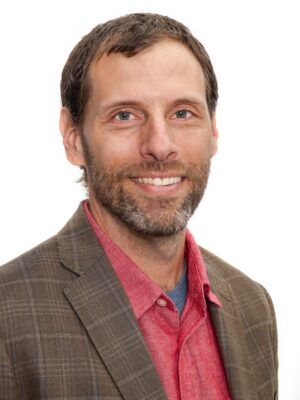
Cohen’s work with the Smithsonian focuses on the intersections of pop culture with political and military history.
Knowledge Cohen gained in chemistry courses has applied to archeological investigations, economics methodologies have informed his research, and staging skills gained during theatre productions prepared him to develop virtual reality exhibits for the Smithsonian.
Cohen added that writing for The Campus newspaper, hosting shows on the WARC 90.3 FM radio station, and serving as the captain of the soccer team during his senior year also inform how he leads.
Mentors Making Lifelong Impacts
Fix credited his academic and personal growth to a series of professors who had a profound impact on him.
He said Emeritus Professor of History Stephen Lyons was the one who sparked his interest in history, and recalled being struck by Lyons’ desire to support him not just as a student, but as a person.
It was over coffee that Emeritus Professor of Classics Samuel Edwards and Emeritus Professor of Economics Earl Adams encouraged him to take a role with the Mystic Seaport Museum that would set up his lifelong career in nautical archeology.
Cohen concurred; Paula Treckel and Jonathan Helmreich — both emeriti professors of history — made a lifelong impact on his curiosity for revolutionary societies. The lessons taught by their professors have been crucial to their work, and continue to be as they research, interpret, and preserve the Gunboat Philadelphia.
“I don’t think there would’ve been a better foundation for my career anywhere else,” Fix said.
Photo credits: Jaclyn Nash; National Museum of American History, Smithsonian Institution
History at Allegheny Communication and Media at Allegheny