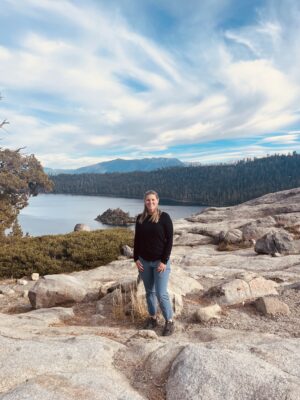
 In early November, Casey Bradshaw-Wilson, Associate Professor of Environmental Science & Sustainability, presented collaborative work at the North American Invasive Species Management Association (NAISMA) conference in Stateline, Nevada.
Partnerships for this project include the Pennsylvania Fish and Boat Commission and Allegheny’s Watershed Conservation Research Center staff (Professors Kelly Pearce, Mark Kirk, Bryan Winston), and Allegheny senior Riley Pegher ’26, who have all contributed significantly to fieldwork associated with this project.
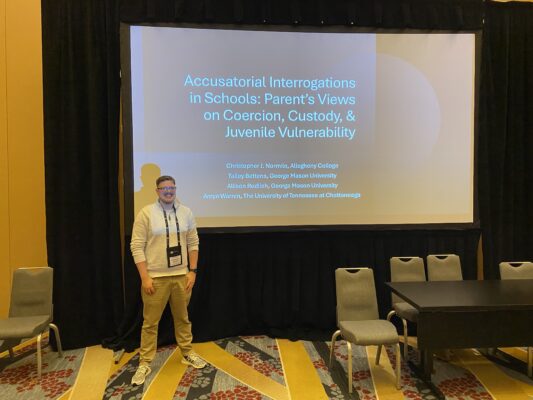 Christopher Normile, A, Assistant Professor of Psychology, recently presented his study entitled, “Accusatorial Interrogations in Schools: Parent’s Views on Coercion, Custody, & Juvenile Vulnerability” with his colleagues Talley Bettens (George Mason University), Allison Redlich (George Mason University), and Amye Warren (University of Tennessee Chattanooga).
In this study, they found that parents view school-based interrogations as coercive and leave students vulnerable, regardless of whether the questioning was conducted by a school principal or a school resource officer (SRO). However, despite seeing both situations as coercive, parents supported legal safeguards for students only when the interviewer was an SRO, not a principal.
This gap in parental expectations matters because students may not receive needed protections during high-stakes questioning by school staff (who are being trained to use highly coercive tactics similar to those used on criminals). Their findings suggest that schools should reevaluate their interrogation policies to ensure consistent safeguards for all juveniles.
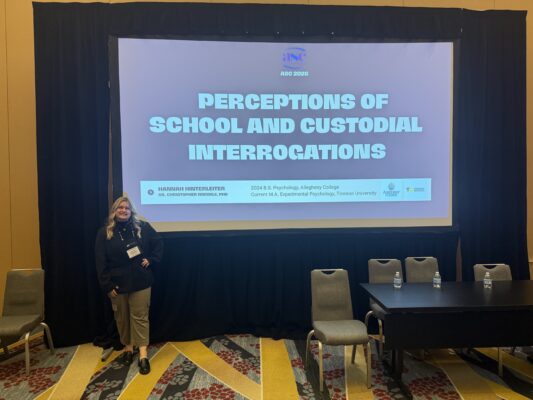 In addition, Hannah Hinterleiter ’24 presented her research project entitled, “Perceptions of School and Custodial Interrogations” during the same symposium.
Hinterleiter’s talk was a continuation of her Senior Comprehensive project, which found that laypeople view the custodial (i.e., police) interrogation as more severe, even though both the SRO and principal used the same interrogation tactics.
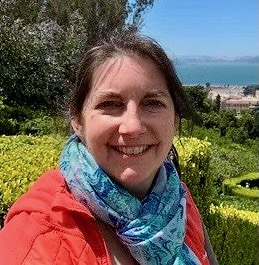 Caryl Waggett, Professor and Chair of Global Health, co-first authored an updated definition of global health, within a working group of the Consortium of Universities for Global Health (CUGH). The updated definition was commissioned and adopted by CUGH, which represents 190+ institutions of higher education across the globe from nearly 50 countries.
The definition was vetted over the course of many months with extensive rounds of blinded communications using a modified delphi process.
The writing team was led by co-first authors: Kathryn H. Jacobsen, Ph.D., MPH, the William E. Cooper Distinguished University Chair (University of Richmond), and Caryl Waggett, professor and chair of global health studies. The initiative was spearheaded by CUGH executive director, Keith Martin, MD PC.
The updated definition replaces an earlier CUGH definition (Koplan 2009), centering health equity as the primary objective of global health education, research, policy, and applied practice. It incorporates an essential understanding of planetary health concepts, which incorporate existential transnational concerns that affect populations across the globe, such as climate change, persistent pollution, and biodiversity loss, and describes a model that showcases various factors that influence global health and are impacted by actions in these sectors.
This updated definition represents an incremental yet vital change for this interdisciplinary, interprofessional field and represents common understandings agreed upon across all parties. The authors affirm calls for continued reflection and dialogue about power dynamics and politics in global health to ensure that the field evolves in ways that are responsive to critical perspectives and changing global realities, and strive with a vision of strengthening, rather than abandoning, global health governance.
Recognizing weaknesses in the current model of international collaboration is a critical first step toward improving the processes and structures that enable governments and their partner organizations to set effective policies, provide services, protect human rights, and build public trust. Since governments and governmental agencies may not always represent the best interests of their populations, especially in fragile states and nondemocratic settings, a model of global health that places the wellbeing of people at the center and welcomes contributions from a range of disciplines, professions, and sectors will be better equipped to meet complex health challenges now and create more effective, inclusive, transparent, accountable, and resilient systems for the future.
 Abigail Riedel ’27 was awarded 1st place overall in the undergraduate student oral presentations at the 21st Annual Regional Science Consortium Research Symposium in Erie, PA.
Her presentation, titled, “The Influence of Forest Structure on Species Richness and Detection rates on Foundation for Sustainable Forest Properties in Northwest Pennsylvania,” started as a summer Office of Undergraduate Research, Scholarship, and Creative Activities (URSCA) project and continued in the fall as an independent study with Kelly Pearce, Assistant Professor of Environmental Science.
Mark Kirk, Research Scientist, and Bryan Winston, Assistant Research Scientist for the Watershed Conservation Research Center (WCRC), both presented research at the 21st Annual Regional Science Consortium Conference in Erie, PA.
Dr. Kirk presented “Trophic Overlap between Invasive Round Gobies and Native Benthic Darters in a Stream Biodiversity Hotspot,” which used gut content analysis to compare diets of gobies and darters within French Creek.
The project’s goal is to better understand how native biodiversity can limit the performance and potential of biological invaders. This project is part of a larger project supported by Pennsylvania Sea Grant under award NA24OARX417C0151 (Subaward S006013-NOAA) from the National Oceanic and Atmospheric Administration, U.S. Department of Commerce. The statements, findings, conclusions, and recommendations are those of the author(s) and do not necessarily reflect the views of the National Oceanic and Atmospheric Administration or the Department of Commerce.
Winston presented on restoration efforts led by the WCRC within the French Creek watershed. His talk, titled “Long-Term Evaluation of Three Stream Restoration Projects in the French Creek Watershed,” examined changes in fish and macroinvertebrate diversity at three sites before and after restoration. The findings from this work will help guide future riparian restoration practices throughout the French Creek watershed.
WCRC Co-Directors, Kelly Pearce, Assistant Professor of Environmental Science, and Casey-Bradshaw Wilson, Associate Professor of Environmental Science, were co-authors on both presentations.
Lead writing consultant, Nickel Spartz ’26, presented a works-in-progress session about their ongoing research project under the mentorship of Alexis Hart, director of writing, titled “Creative Writing Across the Curriculum: A Space for Students to Express Themselves and Their Interests” at the 2025 joint National Conference on Peer Tutoring in Writing/International Writing Centers Association conference.
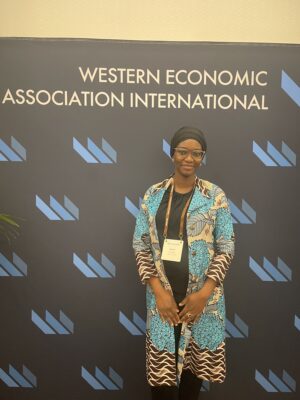 Aisha Yusuf, Assistant Professor of Economics, presented her research titled “The Returns to Migration in Nigeria: Consumption and Geographic Barriers” at the Western Economic Association International (WEAI) 100th Annual Conference in San Francisco, California.
Her research explores how out-migration influences consumption in origin households in Nigeria and the role of geographic barriers in shaping migration decisions and consumption outcomes.

Shannan Mattiace, Professor of Political Science and International Studies, presented a three-hour talk and workshop on political and comparative ethnography at the “Summer School for Mixed Methods,” a week-long workshop for graduate students at the Pontificia Catholic University of Chile in Santiago (January 5-9, 2026). Mattiace was a Fulbright Scholar at the Political Science Institute there in 2019.
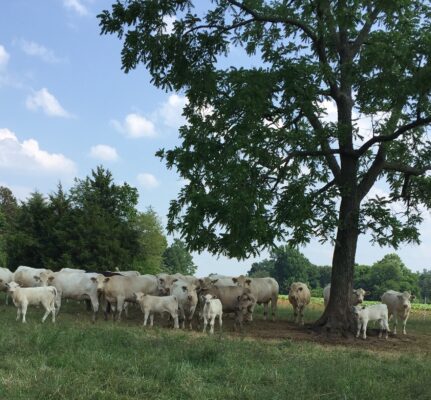
Photo Credit: Adrienne Krone, Beef Cows in North Carolina (June 2015)
Adrienne Krone, Associate Professor of Environmental Science and Sustainability and Religious Studies, published three pieces at the end of 2025.
The first was an article on the term “Animal,” for a special issue of the journal Material Religion. In this article, she used the example of cows to analyze the material presence of animals in religious worlds.
The second article, “Stimulating Shmita: Revisiting Louis Newman’s The Sanctity of the Seventh Year Forty Years Later,” was included in a special issue of The Journal of Jewish Ethics honoring the work of ethicist Louis Newman. Krone’s article focused on his book about shmita, the biblical agricultural sabbatical year.
Finally, Krone published a chapter in the edited volume Judaism in 5 Minutes called “What do Jews do on the Sabbath?” and she would be happy to share the chapter with anyone interested in finding out the answer in just five minutes!

Méndez Guédez visited campus on November 18, 2025
Venezuelan-Spanish author Juan Carlos Méndez Guédez, who visited Allegheny College in November 2025, facilitated the publication of Shannan Mattiace’s introduction/essay on the translation of his novel, Los maletines, into English in the Venezuelan journal, Entreletras, No. 19 (January-June, 2026).
Tim Bianco, Assistant Professor of Economics, published an article in Contemporary Economic Policy titled “The Effect of Household Debt on Safety-Net Participation,” coauthored with Nicholas Moellman (Winthrop University).
The study examines whether rising household debt impacts reliance on government safety-net programs. Using a state-level panel, they find that increases in debt are associated with higher enrollment in the Supplemental Nutrition Assistance Program (SNAP), but not with enrollment in cash welfare programs like Temporary Assistance for Needy Families (TANF).
In other words, their results suggest that higher household debt leads households toward participating in food assistance programs, but not necessarily toward cash welfare. Altay Baskan ’22, Aaron Chisholm ’22, and Raymond Englert ’22 provided research assistance.
Bianco also recently presented joint research with Gary Cornwall (Bureau of Economic Analysis) and Beau Sauley (Murray State University) at the 2025 Southern Economic Association meetings in Tampa, Florida.
He chaired a session titled “Housing Markets” and presented new work titled “Housing Markets, Deregulation, and Mortgage Credit: Insights from the Sand States and Other Regions.”