



You know those animals and random small creatures you choose to ignore? Jason Bittel really wants you to care about them.
Not just the whales and wolves. Not just the pandas and penguins. He wants you to look more closely at the yellowjackets circling your picnic, the opossum darting across a country road, or the white-tailed deer standing motionless at the edge of a Crawford County forest.
And then he wants to tell you why those creatures are astonishing.
The 2006 Allegheny College graduate has built a career out of turning overlooked wildlife into unforgettable stories. As a science writer, author, National Geographic contributor, and children’s book creator, Bittel specializes in translating dense scientific research into writing that is funny, accessible, and deeply human.
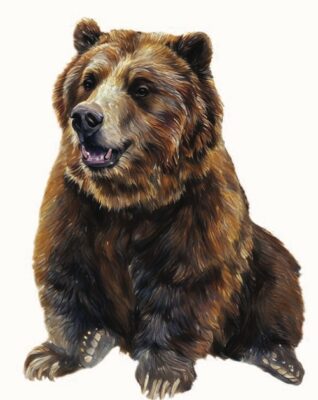
Credit: Joel Sartore, Lisa Monias, National Geographic Books
“I usually say that I serve up science for picky eaters,” he says.
That approach is front and center in his latest book, “Grizzled: Love Letters to 50 of North America’s Least Understood Animals” which explores creatures ranging from jellyfish and freshwater mussels to daddy longlegs and deer.
Rather than focusing only on charismatic megafauna, such as the lions, pandas, and penguins that dominate most wildlife books, Bittel turns his attention toward the animals people swat, overlook, or dismiss.
“Every animal,” he says, “is the product of millions of years of evolution.”
Bittel, who grew up in Acme, Pennsylvania, did not arrive at Allegheny with a clear roadmap toward wildlife journalism. He studied English and political science and says he barely realized science writing was even a possible career.
But several professors helped point him in that direction.
A nonfiction writing class taught by Ben Slote (now professor emeritus) first sparked his interest in the genre. Later, environmental writing courses with former Allegheny professor Kerry Neville introduced him to writers such as Edward Abbey, John McPhee, and Annie Dillard.
“It truly all began at Allegheny College,” Bittel says.
The College also gave him room to experiment. As part of his senior comprehensive project, Bittel wrote a collection of personal essays, including one that blended research, field reporting, and reflections on the death of his father. While working on that piece, he attended meetings of the Quality Deer Management Association (National Deer Association) and explored the role that hunting played in his family life.
The experience helped him realize he could combine reporting, science, storytelling, and personal voice into something entirely his own.
“That freedom to try to write like the big-name authors I was reading at the time, combined with the realization that I could diverge from their paths with my own voice, would ultimately be absolutely critical to my journey of becoming a science writer,” he says.
Northwestern Pennsylvania also left its mark on his imagination.
While developing “Grizzled,” Bittel chose white-tailed deer as an early sample chapter because he considered them “the most boring animal” he could think of. Instead, he discovered a species with a remarkable evolutionary history, an animal that survived dire wolves and saber-toothed cats and adapted to habitats stretching from the Arctic Circle to Argentina.
“We take these animals for granted because there are so many of them,” he says.
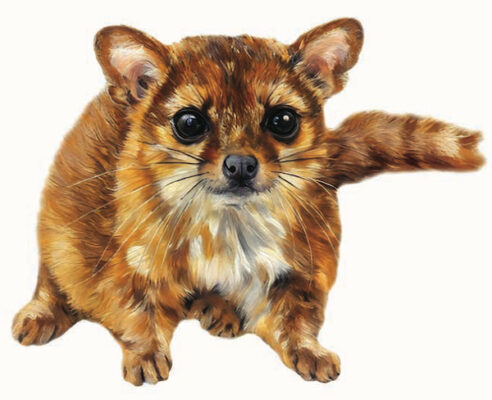
Credit: Joel Sartore, Lisa Monias, National Geographic Books
That curiosity about everyday wildlife has carried Bittel around the globe.
Over the years, he has trapped wild boar, assisted with bull shark research, caught bats near ancient Maya ruins, and stood beneath the moonlight with elephants while lions roared nearby.
His work has appeared in National Geographic, The New York Times, Smithsonian Magazine, and The Washington Post, among many others. He is also a National Geographic Society Explorer and a Knight Science Journalism project fellow at the Massachusetts Institute of Technology. You can find out more at his website.
Today, Bittel works at Carnegie Mellon University, where he communicates complex scientific research to the public while continuing his freelance wildlife writing.
Still, one of his proudest moments happened quietly at home. After nearly 10 years of false starts and revisions, he finally opened a shipment containing author copies of “Grizzled.” His 11-year-old son immediately sat down at the kitchen table and began reading the chapter about orcas.
“He was two when I sent the first email for this idea,” Bittel says.
For a writer who has spent his career helping readers rediscover wonder in the natural world, it felt like the perfect audience.
Study English at Allegheny Study Political Science at Allegheny