
When Lisa Whitenack teaches comparative anatomy to her Allegheny College students, she approaches it with enthusiasm, but she wasn’t so thrilled about the textbook she was using.
It was “25 years old, outdated and pricey,” she says, with anatomy books ranging from $60 to more than $100, plus a lab manual, which can be another $100.
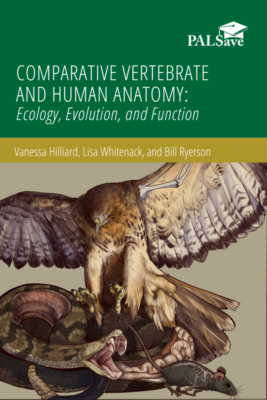
So Whitenack, a biology professor, and two colleagues, Vanessa K. Hilliard of Saint Mary’s College and Bill Ryerson of Cornell University, put together a new textbook, titled Comparative Vertebrate and Human Anatomy: Ecology, Evolution, and Function, a full-color, peer-reviewed, open-access textbook published by PALNI Press/DePauw University Libraries.
It’s free, online, and adaptable. Two additional Allegheny faculty members, biology professor Brad Hersh and assistant professor Jenn Houtz, also joined the list of authors.
“When our team was brainstorming authors for the various chapters, Professors Hersh and Houtz immediately came to mind,” Whitenack says. Hersh wrote a chapter on development and genetics; Houtz tackled the endocrine system.
For Whitenack, open access was the main focus of the project.
“The biggest advantage of open educational resources is that anyone can learn from them, as long as they can hop on the Internet,” she says. It “removes a significant financial barrier,” which is a win for Allegheny students and learners everywhere.
Plus, it’s easy to update. “We can quickly update our book as scientific advances are made,” she notes. “Even in a discipline as old as anatomy, discoveries are made constantly.”
Quality matters, too. “One challenge of adopting any open educational resource is that anyone can put something online,” she acknowledges, “and if it hasn’t gone through a rigorous peer review process, you don’t know how accurate it is. The good news is that our textbook has been peer-reviewed by experts in the field.”
Whitenack’s classroom perspective helped shape the text. “When I teach my courses at Allegheny, I often teach students that people are behind science and that science affects people. This led me to write an entire chapter that is a more honest history of the field of comparative anatomy, from the erasure of non-Western scientists from the narrative, to the weaponization of anatomy to support racism and homophobia, to ignoring the contributions of women, and more. We also weave this into several chapters throughout the book.”
Her research in paleobiology and evolution guided her contributions to two chapters on vertebrate evolutionary history. She also wrote chapters on the urogenital system and helped with one on circulation, systems she regularly teaches.
The textbook’s modular structure makes it easy to navigate. “You don’t have to read it in chapter order to understand it,” she says. It also embeds five core concepts of comparative anatomy, with human sections linked back to broader vertebrate patterns.
Whitenack is using the text now in her comparative anatomy course, a class about the anatomy of various vertebrates, or animals with backbones, which is held every fourth semester. She also expects the textbook will support Senior Comps and other coursework. “This definitely has a cost-saving aspect for Allegheny students who want to take an anatomy course,” she says.
One goal remains: “Now I just need someone out there to pick up the baton and write an open-access lab manual.”
Until then, this Allegheny-rooted resource is changing the way students learn in a way that is flexible and free.