
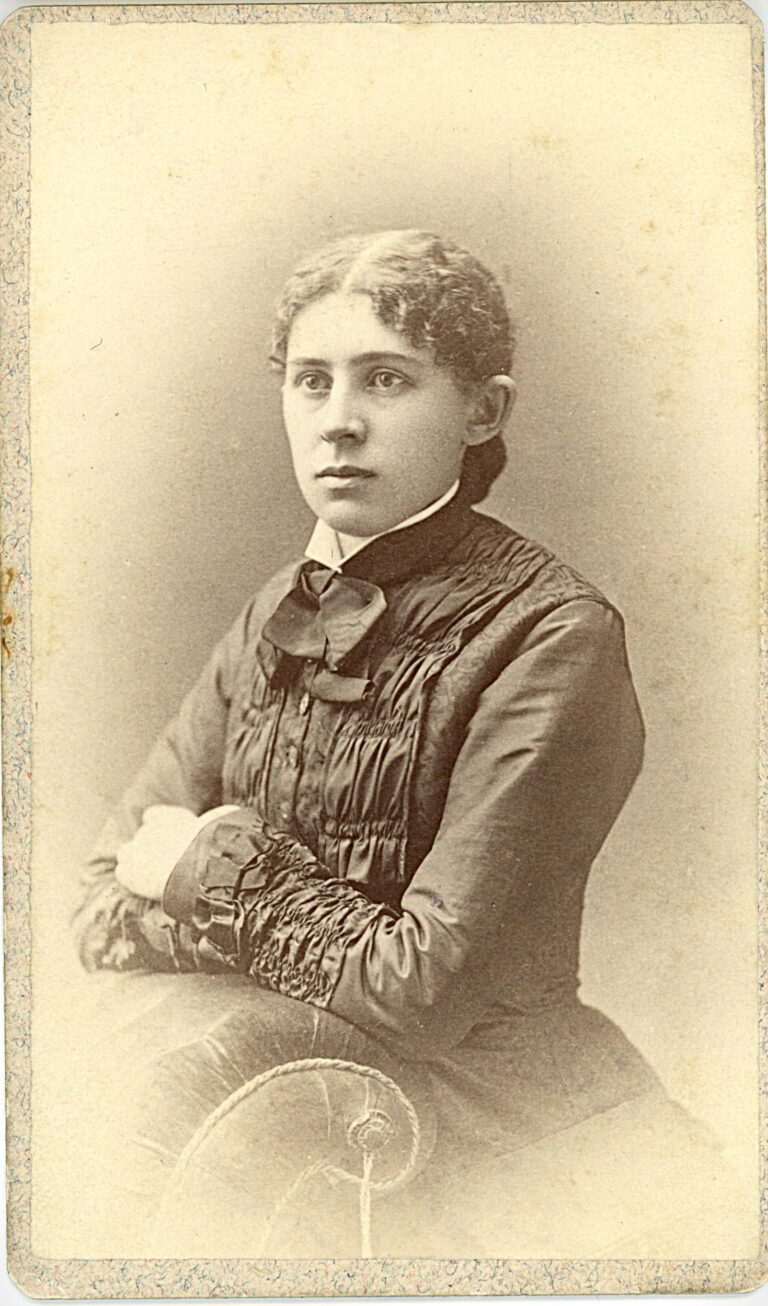
A leading force in American journalism, a product of the liberal arts, Ida Minerva Tarbell is best known for her 19-part series “The History of the Standard Oil Company” published from November 1902 through October 1904 in McClure’s Magazine. Published as a book in 1904, Tarbell’s work helped focus attention the growing issue of monopolies in the first decade of the twentieth century and was the catalyst leading to the U.S. Supreme Court’s landmark 1911 decision to break up the Standard Oil monopoly.
“Imagination is the only key to the future. Without it none exists—with it all things are possible.”
In 1999, the NYU Department of Journalism ranked The History of the Standard Oil Company number five in a list of the top works of journalism the twentieth century.
On October 7, 2000, Ida Tarbell was inducted into the National Women’s Hall of Fame in Seneca Falls, New York. Paula Treckel, Professor of History at Allegheny College, accepted the award on Ida Tarbell’s behalf.
The U.S. Postal Service commemorated Tarbell on September 12, 2002 in a set of Four Women in Journalism stamps that were issued in recognition of the talents of Ida Tarbell, Marguerite Higgins, Ethel Payne and Nellie Bly. The collage on the Ida M. Tarbell stamp features a black-and-white photograph of Tarbell. To the right of the photograph is a portion of the headline “The History of the Standard Oil Company,” as well as a portion of the McClure’s Magazine header, both from page 3 of the magazine’s November 1902 issue.
Ida M. Tarbell: Investigative Journalist Par Excellence
By Arthur L. Lowrie, Allegheny College, Class of 1955
Investigative journalism is the contemporary journalist’s path to fame and fortune and the competition is fierce. Success in uncovering misdeeds by the rich and powerful can mean instant fame, TV talk shows, and perhaps a movie. With such rewards, the temptation is great to exaggerate the sin, omit relevant facts, and follow only those leads that may confirm the evil deed. Such lapses will go unnoticed by most readers and ignored by those who celebrate scandal and enjoy higher profits.
Ida Tarbell (1857-1944), the sole woman who matriculated in 1876 and graduated in Allegheny College’s class of 1880 [see additional note below], was America’s first great woman journalist. She set an example that today’s practitioners would do well to emulate. A relentless pursuit of all the facts and fairness in presenting them marked her writing throughout her career. She also refused to exploit her professional accomplishments for monetary gain or celebrity status.
In her first major work, Miss Tarbell studied Madame Roland to confirm her view that women brought moderation and compassion to politics. After completing her research she reluctantly concluded that Madame Roland had behaved during the French Revolution much as men had. This conclusion no doubt contributed to her later, and unpopular, rejection of some positions of the suffragettes, particularly their insistence that men had corrupted the world and women could straighten it out.
In her most famous work, The History of the Standard Oil Company (which oil historian Daniel Yergin called the “most important business book ever written”), Miss Tarbell revealed, after years of painstaking research, the illegal means used by John D. Rockefeller to monopolize the early oil industry. Yet Miss Tarbell interspersed in her condemnation of Standard Oil’s illegal practices, praise for Rockefeller’s enormous accomplishments in organizing and stabilizing a volatile industry. She rejected being labeled a “muckraker” (despite its popularity), because “I was convinced that in the long run the public they were trying to stir would weary of vituperation, that if you were to secure permanent results the mind must be convinced.”
Ida Tarbell had many opportunities to capitalize on her reputation as one of America’s most respected journalists. Instead, she rejected the pleas of the suffragettes to endorse their causes because they contradicted her own convictions about the role of women. In 1914, Henry Ford and others tried unsuccessfully to have her join the celebrity-laden “Peace Ship” to bring an end to World War I. She considered it totally unrealistic and said so. In late 1916, she turned down President Wilson’s offer to make her the first woman on the Tariff Commission because he believed she had written more common sense about the tariff than any man. Finally, she put off writing her autobiography until she was eighty years old, and even then it was a work of such modesty and self-effacement that it added little to her popularity.
The lasting results of Ida Tarbell’s brand of investigative journalism, which include the 1911 Supreme Court decision to break up the Standard Oil trust, suggest that her career, characterized by thoroughness, fairness, and intellectual integrity, should be studied by any journalist more interested in recording and influencing events that achieving celebrity status.
NOTE: According to Allegheny’s records, three women, who did not matriculate in 1876, also graduated in 1880.
Copyright 1997 by Arthur L. Lowrie. All rights reserved. This work may not be used for any reasons other than noncommercial research and scholarship.
Ida M. Tarbell: A Selective Bibliography
Primary Sources
- All in a Day’s Work: An Autobiography. New York: Macmillan, 1939.
- The Business of Being a Woman. New York: Macmillan, 1912.
- Father Abraham. New York: Moffat, Yard, 1909.
- The History of the Standard Oil Company. 2 volumes. New York:McClure, Phillips, 1904.
- The Life of Abraham Lincoln, Drawn from Original Sources and Containing Many Speeches, Letters and Telegrams Hitherto Unpublished. 2 volumes. New York: McClure, Phillips, 1900.
- Madame Roland: A Biographical Study. New York: Scribners, 1896.
- A Life of Napoleon Bonaparte. New York and London: McClure, Phillips,1901.
- The Tariff in Our Times. New York: Macmillan, 1911.
- The Ways of Woman. New York: Macmillan, 1915.
- The University of Pennsylvania’s Online Books by Ida M. Tarbell page.
Secondary Sources
- Brady, Kathleen. Ida Tarbell: Portrait of a Muckraker. New York: Seaview/Putnam, 1984.
- Camhi, Jane Jerome. Women against Women: American Anti-Suffragism,1880-1920. Brooklyn, NY: Carlson Publishers, 1994.
- Goodwin, Doris Kearns. The Bully Pulpit: Theodore Roosevelt, William Howard Taft, and the Golden Age of Journalism. Simon & Schuster, 2013.
- Gorton, Stephanie. Citizen Reporters: S.S. McClure, Ida Tarbell and the Magazine that Rewrote America. Ecco, 2020.
- Kochersberger, Robert C. More Than a Muckraker: Ida Tarbell’s Lifetime in Journalism. Knoxville: U of Tennessee Press, 1994.
- Tomkins, Mary E. Ida M. Tarbell. New York: Twayne Publishers, 1974.
- Weinberg, Steve. Taking on the Trust: the Epic Battle of Ida Tarbell and John D. Rockefeller. W.W. Norton, 2008.
From the Ida M. Tarbell Collection
A selected sampling of her writings, one being a character sketch of John D. Rockefeller that was written for McClure’s Magazine, and photographs from the collection. Several of these documents are unpublished works, others have been out of print for decades, and some are from Allegheny College’s publications.
The papers of Ida M. Tarbell have been digitized and are available to the public.
Articles
- The College Graduate in Her Community: Found in the Tarbell Collection as a galley proof, the ultimate publication source of this document was v. 24, n.1 of the The Journal of the American Association of University Women.
- What I should Like to Tell June Graduates: A manuscript found in the Tarbell Collection. It is the draft version of a commencement address for Allegheny College class of 1913.
- Life at the Sorbonne: in Women’s Edition of The Campus, v.11, n.15 (June 18, 1895).
- What a Factory Can Teach a Housewife: in Association Monthly by the YWCA of the USA. v. 10, n.11, pp.422-423.
- John D. Rockefeller: A Character Study (Part 1): in McClure’s Magazine. July 1905, pp.[226]-249.
- Founders Day: in Allegheny College Bulletin. March-May 1923, pp.10-16
- Death of an Alumna: Ida Tarbell’s obituary in Allegheny College Bulletin. April 1944, p.4.
Ida Tarbell and the Business of Being a Woman
By Paula Treckel – Professor of History, Allegheny College
“What I discovered, or was allowed to discover by a woman who was as self-consciously remote in her correspondence as she was in person, was disturbing… this woman, who personified the word “success” in her own generation, and who, if she were alive today, would stand at the forefront of journalism, was the same woman who asserted that women’s place was in the home and that they were incapable of greatness in a man’s world because of their nature.”
My interest in Ida Tarbell was first sparked when, as a young girl studying American History in elementary school, Ida Tarbell’s name appeared on the pages of my history book. Whether it was because she was one of the few women mentioned –along with Pocahontas, Abigail Adams, Betsy Ross and Harriet Beecher Stowe–or because of her “funny name” and appellation “muckraker”, I tucked her away in my memory. All the while, of course, forgetting the more important people and events of America’s past!
Perhaps it was my brief encounter with Ida as a child, and with only a few others women deemed significant in creating the America nation, that led me to question the absence of women from history books and devote myself to the search for their past. When I was hired to teach American women’s history at Allegheny College, I looked forward to looking at the College’s extensive collection of its most illustrious graduate–Ida Tarbell. This would be the ideal opportunity, I thought, to investigate this shadowy figure from my childhood, using her own letters, works, her private as well as her public correspondence.
What I discovered, or was allowed to discover by a woman who was as self-consciously remote in her correspondence as she was in person, was disturbing. For what was revealed to me in this remarkable woman’s literary remains was an enigma–a woman who exemplified an incomprehensible mixture of opposing qualities and defied my understanding.
Let me outline my confusion.
I found Tarbell an intelligent, resourceful, strong, courageous, forceful, single-minded, successful woman. Remarkable in her determination to pursue a career during an era in American history when it was still unusual for women to attend college let alone seek a life outside the home. Yet, this woman, who personified the word “success” in her own generation, and who, if she were alive today, would stand at the forefront of journalism, was the same woman who asserted that women’s place was in the home and that they were incapable of greatness in a man’s world because of their nature. That career women were freaks and misfits, doomed to failure and dissatisfaction. That women were intellectually unable to cope with the problems and complexities of the man’s world and therefore should not be granted the right to vote.
My initial reaction to this discovery of these contradictions between Tarbell’s life and her beliefs was anger, and yes, a sense of betrayal.
How could she, a woman who had accomplished what millions of women then and now sought to attain, deny her very achievements and thus, her life? For in her remarks women’s roles and rights, Tarbell publicly rejected the very premise upon which her own life was based–that women were not only men’s equals, but that they had the right to participate in the public sphere, long the preserve of men. She used her considerable influence as a path breaking journalist to campaign against not only women’s suffrage but women’s involvement in the professions.
My frustration was best articulated by Jane Addams, the Progressive reformer. When Addams heard Tarbell say that women’s suffrage was not only unnecessary but wrong and that women’s participation in politics and government was against their “true” nature, she bluntly concluded: “There is some limitation to Ida Tarbell’s mind.”
Why? Why did Tarbell try to convince other women to give up the battle for the vote, for equal rights, and for access to careers?
Her life reveals the high cost of being a pioneer, a ‘token’ female, always the ‘exception’ to the rule.
In many ways, Ida Tarbell exemplified the dilemma of many women at the turn of the century. She was reared in a culture that believed that women and men were different and had complimentary natures: Women were thought to be morally superior to men, but men were women’s intellectual superiors. Women were emotional and ruled by their hearts. Men were ruled by their heads. Thus, it was argued, the brutal public arena of commerce, trade and politics was better left to men. Fragile, vulnerable women should be sheltered and protected in the home.
But the post-Civil War world in which Ida Tarbell came of age also witnessed great change. Immigration, industrialization, urbanization, and American imperialism, transformed the nation. Many concerned Americans–some who wished to preserve the past, others who embraced the future–became convinced that reform of society and government was necessary. Fortified by the Social Gospel movement, people across the land were urged to put their Christian principles into action. They were told they were “their brother’s keeper” and exhorted to become involved, to improve themselves and the world around them.
Many believed that women had special qualities and skills to bring to this Age of Reform. Women’s innate difference from men–their moral superiority, their purity and their compassion–made them especially suited to the campaign to “uplift” America. Their skills as mothers and homemakers would help them diffuse the hot tempers of urban politics and “clean up” the corrupt cities. But to do so, women required the vote. And so it was that women’s suffrage gained much wider acceptance during the closing years of the twentieth century as a tool for progressive reform.
This was the world, and these were the values that shaped Ida Tarbell.
But, to succeed in the male-dominated world of journalism, Ida had to repudiate–for herself at least–her culture’s ideas about women’s “special” nature. She was different from other women, she believed. The exception that proved the rule. Extremely self-conscious of her pioneering role, but lacking confidence in her own ability as a writer, she jealously guarded her position from would-be challengers and new comers, and held everyone at arms’ length. For Tarbell the price of success was high: love not shared, friendships not sustained, children not born.
Was the price she paid for her success too high?
I believe that Ida Tarbell began to regret some of the choices she made. But rather than taking responsibility for her decisions or faulting the culture that demanded that women choose between love and work, she blamed feminists for daring women to dream. She accused them of falsely telling women they were the equals of men; that they had a right to be whomever they wished to be. She chastised feminists for disparaging women’s “noble” calling as housewives and mothers and urging women to take their place on the political stage. Instead, she argued that women did not have the capacity to achieve greatness in men’s world and implored them to stay at home, raise their families, and leave politics and industry to men.
But in arguing against women’s equality and for their return to the home, Ida Tarbell repudiated her own accomplishments. Did she not see the inconsistency between her life and her words? Or was she unable to face it?
I believe that Ida’s self-doubt and her anti-feminism are two sides of the same coin, and both were a consequence of her success in a hostile, doubting society. Her life reveals the high cost of being a pioneer, a “token” female, always the “exception” to the rule. Ida felt she had to hide her insecurities and deficiencies from the men around her. But at the same time she distanced herself from other professional women who might have seen the truth beneath the mask she wore. In doing so, she cut herself off from the support, encouragement, and understanding these women could offer her. Sadly, despite her great success as a journalist and writer, Ida found herself isolated and alone. Studying Ida Tarbell’s life can help us better understand the difficult choices encountered by other pioneering professional women in 19th century America. And, perhaps even holds some important lessons for women of achievement today.
Let us, then, unravel Ida Tarbell’s tangled life and see how she struggled with what she called “the business of being a woman.”
Originally presented as a lecture by Professor Emeritus of History Paula Treckel at the Chautauqua Institute in August 1997. Treckel, joined the Allegheny College faculty in 1981 and retired in 2014. She was the 1996 recipient of the Julian Ross Award for Excellence in Teaching. She is the author of To Comfort the Heart: Women in 17th Century America.
Copyright 2002 by Paula Treckel.
Remarks on the Induction of Ida Tarbell into the National Women’s Hall of Fame
By Allegheny College Professor Emeritus of History, Paula Treckel
October 7, 2000—Seneca Falls, New York
On behalf of the students, faculty, administration and alumni of Allegheny College, I would like to thank the Board for their selection of Ida Minerva Tarbell as an inductee into the National Women’s Hall of Fame.
Born and raised in the oil-rich hills of western Pennsylvania, Ida Tarbell was an eyewitness to history. Her first memory was of the assassination of President Abraham Lincoln and during her childhood she had a front row seat to the birth of America’s oil industry. She watched as John D. Rockefeller’s Standard Oil trust gobbled up his competitors in the oil business.
As a young adult, Ida was fascinated by the sciences and driven to understand the world she saw through her microscope. Intelligent and curious, she sought a higher education at Allegheny College, a small liberal arts college in Meadville, PA. where, as the sole female member of the class of 1880, she studied the sciences and history, preparing herself for life as an independent, single woman.
As a writer for The Chautauqua Magazine, Ida Tarbell quickly found her calling–that of a journalist. Freelancing articles for American magazines while living in Paris, she came to the attention of editor Samuel S. McClure, whose magazine, McClure’s, practiced a new kind of journalism–journalism with a “conscience.” She couldn’t resist his offer to join his staff in 1894.
Ida Tarbell’s first major story for McClure’s was a biographical series on Napoleon, followed by another on her childhood hero, Abraham Lincoln. But then it was suggested that Tarbell write about the industrial monopolies strangling the life out of America’s businesses. Recalling her childhood on the Pennsylvania oil frontier, she rolled up her sleeves and took dead aim at exposing John D. Rockefeller’s Standard Oil Company.
Ida Tarbell’s History of Standard Oil, published as a book in 1904, was a tour de force. Her tenacious research, her meticulous attention to detail, and her scrupulous devotion to the truth exposed the illegal activities of Rockefeller’s trust for all the world to see. It quickly became a hallmark of a new breed of investigative journalism. An angry, irritated President Theodore Roosevelt labeled this new generation of journalists, epitomized by Ida Tarbell and her History of Standard Oil, “muckrakers.” And Ida Tarbell was known as the foremost “Lady Muckraker” of her time. As a consequence of her work, the U.S. Government brought suit against Standard Oil for violation of the nation’s anti-trust laws and in 1911 the nation’s most powerful monopoly was broken.
Although paradoxically, perhaps, she never supported women’s right to vote, Ida Tarbell was a role model for generations of young women eager to follow in her footsteps. Her long career as a journalist brought her much acclaim. In 1922, The New York Times named her one of America’s Most Admired Women. But even though she dined with Presidents and potentates, interviewed business leaders and dictators, and traveled around the world, at heart she remained a modest, humble woman, true to the values instilled in her during her youth in western Pennsylvania.
Of all the books and articles she wrote during her lifetime, Ida Tarbell was most proud of The History of Standard Oil. Shortly before her death on January 6,1944 she was asked by a young history professor, “If you could rewrite your book today, what would you change?” “Not one word, young man,” she stoutly replied, “Not one word.”
I thank the National Women’s Hall of Fame for recognizing Ida Minerva Tarbell’s outstanding contribution to the field of American journalism. And I am proud to accept this honor in her behalf.
The Staff Breakup of McClure’s Magazine
“The Explosions of Our Fine Idealistic Undertakings”
By Greg Gross, Allegheny College class of 1983
Preface
This thesis analyzes the staff breakup of McClure’s Magazine and demonstrates its historical significance by placing it in the context of the progressive era. The McClure’s schism occurred in late March and early April, 1906, and triggered the gradual decline of one of the era’s most popular mass-circulation periodicals. To present this study in a logical manner, I have divided this thesis into three segments, which can best be visualized by imagining three concentric spheres. The “outer sphere,” Chapter I, analyzes the rise of the progressive mentality, which had a strong influence on American culture at the dawn of the twentieth century, from approximately 1900-1912. I introduce the reader to the outer layer of my area of study, presenting an analysis of the origins of progressivism and its Protestant-oriented, middle-class character.
Chapter II, the “middle sphere,” chronicles the rise of McClure’s Magazine to national prominence as the forerunner of the muckraking movement. I introduce the central figures responsible for the expose journalism that “arraigned,” on a nationwide scale, the lawlessness and immorality of the American people, while analyzing the staff’s ideological ties to progressivism.
In Chapter III, the core of this thesis, I explore the ideological tensions that wrenched apart the McClure’s staff. Samuel Sidney McClure, the majority stockholder and chief editor of the magazine which bore his name, committed the “sin” of adultery, which affronted the moral standards of the progressive mentality. His staff reacted by sternly disapproving of his actions. Their disdain caused McClure to suffer from feelings of guilt, which aggravated his already unstable mental condition. In the face of his colleagues’ disapproval, he sought to regain their esteem by establishing a business empire which would serve society. McClure undertook to establish a new magazine,McClure’s Universal Journal, and subsidiary enterprises, including a bank, life insurance company and correspondence school, all geared to serve the “common man.” McClure’s “grandiose scheme” backfired, however, and only succeeded in convincing his staff that he was attempting to found a trust-like business conglomerate.
Convinced of their editor’s mental instability, and affronted by love affairs and unrealistic schemes they considered economically dangerous and morally untenable, the McClure’s staff left the magazine. Ida Tarbell, one of the “insurgents,” aptly summarized the breakup as “the explosions of our fine idealistic undertakings.” (1) I ultimately seek to demonstrate the relationship between these exploded ideals and the movement which nurtured them.
My thesis is intentionally limited to an analysis of how the McClure’s staff members perceived themselves and their mission; this paper is not, nor was it intended to be, a comprehensive history of muckraking or progressivism. Wherever possible, I have used the primary resource materials of the Ida M. Tarbell Collection at Pelletier Library, Allegheny College. The Tarbell Papers proved invaluable in assessing the tensions which led to the breakup of a prominent progressive magazine and the staff that created it.
Reface Endnotes
“IMT Collection” designates Ida M. Tarbell Collection.
(1) Ida Tarbell to Ray Stannard Baker, October 17, 1939, IMT Collection, Correspondence between Ida Tarbell and Ray Stannard Baker file, Allegheny College Library, Meadville, Pennsylvania.